Welcome back! The previous installments felt too hefty so we’re going to cut this one to a half block of Stone Way. If the west side of the 3500 block felt like a greatest-hits mix of fish and chips, beer and chocolate, the east side is where Stone Way’s modern era really shows itself. The buildings here are newer but the block’s story starts with old Fremont basics: fuel and feed.
The evo(lution) of this corner
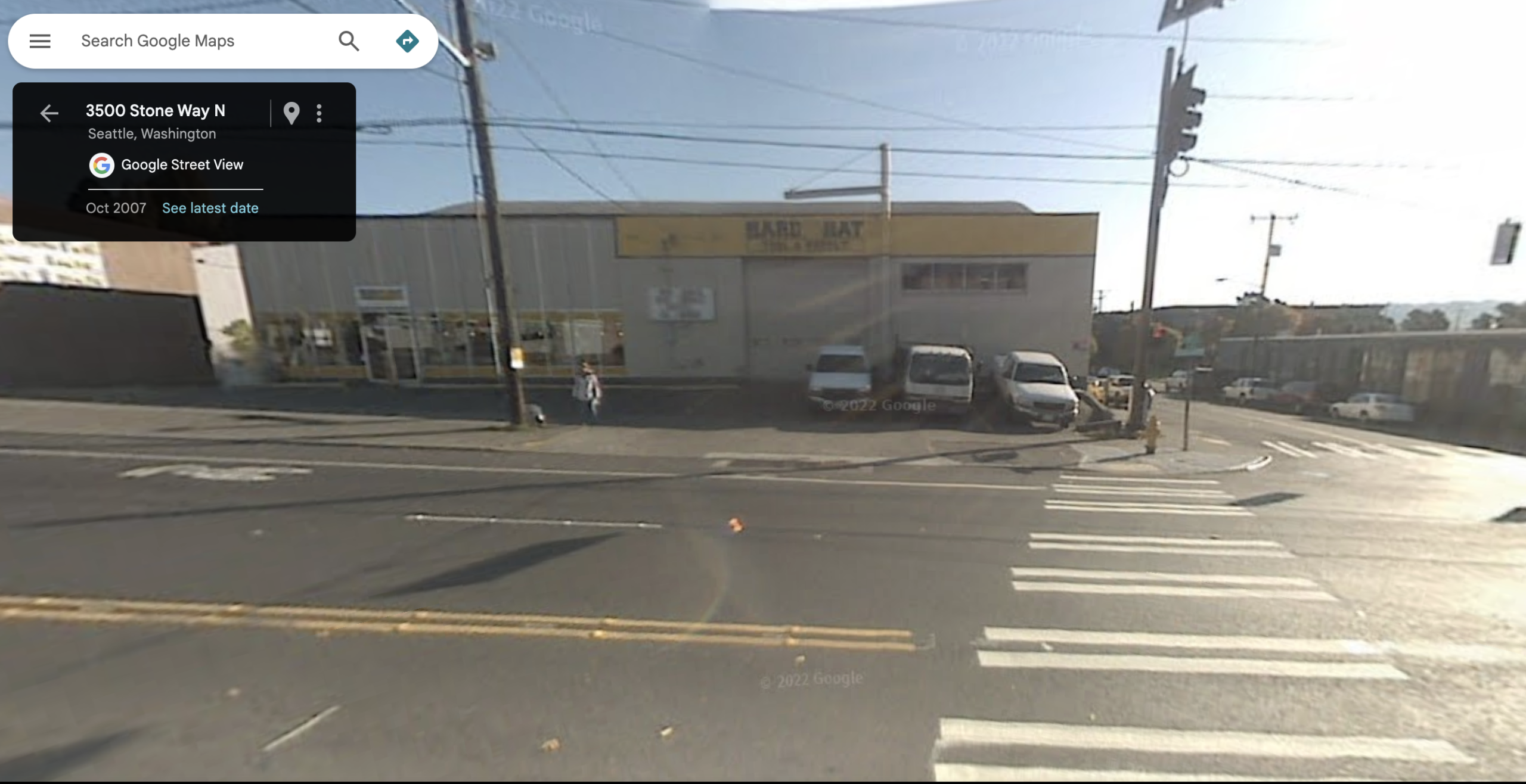
According to the Fremont History website, back in the 1930s, the 3500 block was home to Stoneway Hay & Grain, a mattress-and-rug shop, and even a fuel yard. Coal, hay, and kindling were daily needs, and small industrial businesses filled the corridor. By the 1950s, the hay and fuel operations faded out and one-story commercial buildings took over. We don’t have any historical photos handy but you can see the 1960s era masonry building in a previous form in this 2007 Google Street View snapshot.

In 2012, the masonry building was reinvented as The Fremont Collective. It helped set the tone for Stone Way’s modern look: outdoor retail, destination dining, and community gathering spaces under one roof. Evolution Projects, the group behind the redevelopment, describes it as one of their earliest “flag planting” projects on lower Stone Way.
evo Seattle (3500 Stone Way N)
The anchor here is evo Seattle, the flagship store for the outdoor gear retailer. It’s basically a checklist of everything Pacific Northwestern: alpine, snowboard, wake, skate, bike, surf, camping, and clothing all under one roof.
This isn’t evo’s first Seattle location. They opened their first retail outpost in 2005 in a converted warehouse on the other side of Fremont (now outdoor gear consignment store, Wonderland Gear Exchange), helping turn an industrial building into a community hub for Seattle’s action-sports scene. evo has grown into an empire with retail, travel services and even hotels, all over the world.
Did you know that underneath the evo store is All Together Skatepark, Seattle’s only indoor skatepark? It’s a youth-focused, community-minded space designed to be welcoming for all ages and ability levels.
On the northwest side of evo, the block shifts from daytime retail energy to evening destination dining.
Joule (3506 Stone Way N)
The first space at 3506 was home to The Whale Wins, the Renee Erickson restaurant. The restaurant closed permanently last year after 13 years but the stunning The Whale Wins’ mural remains. The space is currently vacant.

Sharing the address is Joule, the Korean and Asian fusion restaurant from chefs Rachel Yang and Seif Chirchi. Joule first opened in 2007 and relocated to Stone Way in 2012, where it continues serving dinner seven nights a week with its open-kitchen energy and heated patio. Their sister restaurant, Revel, is on the other side of Fremont in the Cedar Speedster building, another Evolution Projects development.
Murals at evo Seattle
Two large-scale murals wrap the evo Seattle building as part of the Campus Seattle public art program (more on Campus Seattle later). On the north-facing wall, “Prusik Peak Glow” by Emily Beaudoin (2024) depicts a jagged alpine peak reflected in calm water beneath a crescent moon, inspired by the alpenglow just before nightfall.
On the south side, “Look Back to Look Forward” by The Worst Crew (Pedro Barrios and Jaime Molina) uses bold, graphic forms to reflect on ancestry, labor, and continuity… a reminder that progress along Stone Way is built on the work and dreams of those who came before.
The vision behind the block
The through-line here is Evolution Projects, a Seattle-based development group. Bryce Phillips, a partner at Evolution Projects, is also the founder of evo. That overlap helps explain why evo’s Fremont flagship, All Together Skatepark, and the surrounding mix of outdoor- and community-oriented uses feel so aligned.
Evolution Projects describes its work as “creating special places, rooted in our passion for building community,” and the Fremont Collective was one of the first places where that philosophy took physical form. GeekWire has reported on the broader Campus Seattle vision around this cluster of buildings, noting that the Fremont Collective helped anchor the campus concept as Stone Way rapidly evolved.
What you’ll notice walking this block
The shift from “supplies and storage” to “destination and community” is clear here. The building footprints still do a Fremont job – holding the practical stuff (gear), the fun stuff (skate), and the celebratory stuff (dinner) – just in a 2020s form.
If you’re a longtime neighbor who remembers when this part of Stone Way felt quieter, the contrast tells the story: this block is now one of the clearest examples of how quickly Stone Way went from semi-industrial to one of Fremont’s most active sidewalks.
Coming up next
Next time we’ll keep heading north on the second half of the block where the Campus Seattle story expands into newer buildings, including a mass-timber mixed-use project that’s been central to the corridor’s newest wave of change.